The Innovation Adoption Curve And Artificial Intelligence ...As Told By A Sassy Marketing Nerd. (Not Written By ChatGPT, btw)
"AI will never take your job but the person who knows how to use AI will." - Can't remember.
The Innovation Adoption Curve And Artificial Intelligence
...As Told By A Sassy Marketing Nerd. (Not Written By ChatGPT, btw)
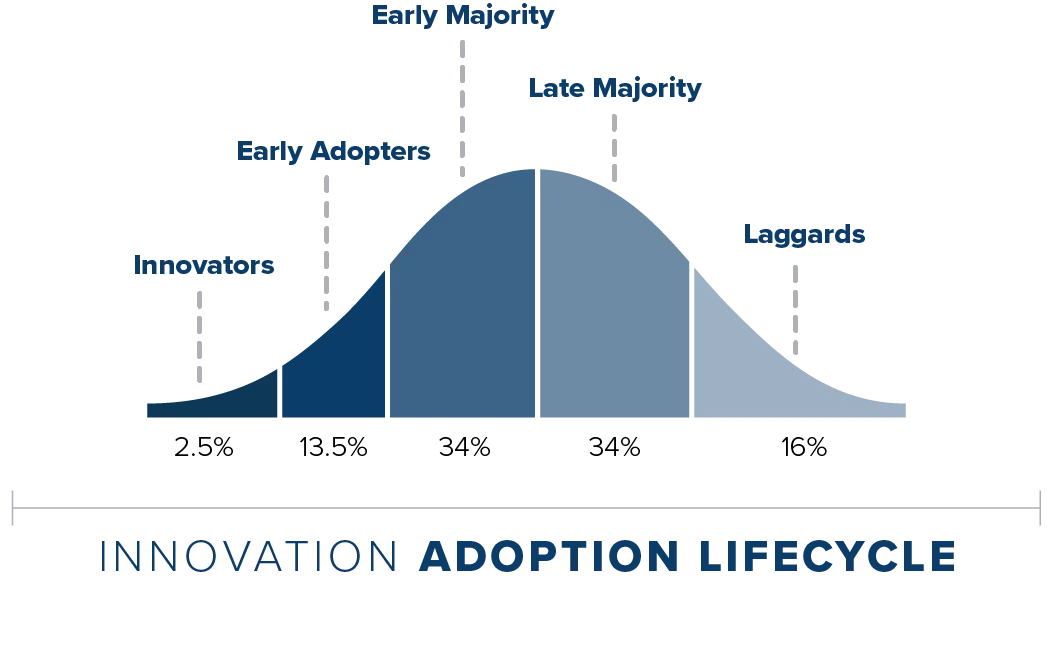
In marketing 101, we learn about this fancy curve by Everett Rogers that really explains the segmentation of consumers. We can use this curve to better understand how technology - and many other things - become mainstream in society. We can use it to explain the rift in generations, like why do old people hate cell phones?
The innovators are the ones who discover a new thing. Never heard about it before, and they give it a try. The technology is untested and they have no idea the extent of what it could be used for but they take the time to learn it from scratch.
The early adopters are actually the most fascinating group of the curve. I love the allegory that was made with a video of a bunch of people sitting down, enjoying a sunny afternoon on a grassy hill at a music festival when all of a sudden, one starts dancing. Granted, it is a music festival but you can tell it's a daytime set of an opener band, probably day 2 or 3 of the festival, everyone looks like they're just taking a break.
Anyway, this guy is dancing LOUDLY, he's letting his freak flag fly all by himself for what feels like an eternity as you're watching him. Suddenly, a second person starts dancing. Eventually everyone joins in and a huge crowd is dancing but there was a moment when that second person took a risk in joining the first person.
Which took more courage? Being the first to look foolish or associating yourself with the fool?
This is how trends are born. Someone comes up with it but it always takes a second person to vouch for it. The early adopters are those trendsetters.
You see it in social media marketing. They're called influencers. Brands use them to endorse their products all day every day. The company who owns the brand is the innovator, the influencer is the early adopter.
--
Back to AI, I fall somewhere in the graph between early and late majority - as most of us do. We've seen other people find success using it. They're saving time on daily tasks, they're working out personal problems using it, they're being entertained by it, they're loving it, it's everywhere. It's now a household name for most of us.
Like my late majority side, I've gone back and forth with it. Dipped my toes in, snatched my toes away. I've heard the negatives, I've seen the unimpressive-ness it's produced. I've been pleasantly surprised by its capabilities and then wildly frustrated with its limitations.
The thing to remember is that these bell curves of innovation apply to technology that's had decades to develop. ChatGPT was released in late 2022. Not even four years ago. I think what we're going to see in the next 10 years is an AI chatbot that's lightyears ahead of what us common users are seeing from ChatGPT. I believe we're all still working with the Beta version right now. My iPhone is a lot more advanced than my Nokia brick phone was.
Yes, I'm old. But not as old as my mother, obviously. I had to unfollow my mom on social media because she makes me cringe. Her use of Facebook gives me second-hand embarrassment. She really likes taking those quizzes that tell you which Disney character you are. She'll type IN ALL CAPS cause she has bad eyes. She'll comment something totally irrelevant. Her second cousin Nance can't find her wallet and my mom will comment I KEEP MY GRANDDAUGHTER'S SCHOOL PITCHER IN MY WALLIT. She can't spell on her phone keyboard either.
The truth is, when we don't grow up using this technology, the way we use it is going to be much different than someone who learned to use it early on. I'll still be looking up sourdough recipes on my AI chatbot while my kids are blueprinting out city plans for rerouting Lake Hartwell's energy production (if AI hasn't dried it all up by then, I don't know, I haven't done my research on that) - my point is that if we can't even fathom the extent of its capabilities, we'll never be able to use it to it's fullest potential.
One thing I do know, we have to stop asking it to impersonate humans. My favorite thing about AI right now is that I can still tell what was created by AI. I can tell by how something is written and how something looks. ChatGPT might as well put a watermark on everything it creates. Repetitive literary devices, words, animation style. And that's if it doesn't mess up and give you six fingers on one hand.
In my line of business, I have full confidence that the convenience AI provides in the marketing world will soon lose value in the face of human creativity. We just do it better!
Maybe that makes me more of a laggard on the graph than I thought. I do identify with the traditionalists, I'm even slightly resistant to change - or I'm at least going to have an opinion about it. Laggards use new technology only after it's been mainstream and only if it's absolutely necessary.
Who are the top five people you communicate with on your phone? Can you remember each of their phone numbers? You're lucky if you can remember one. But your really don't need to remember any of them anymore. Your phone has all of that saved, right at your fingertips when you need it. Lost your phone? No worries - it's backed up in the cloud. Yup, here's the 'technology makes us dumber' argument. Which is ironic because my career surrounds technology.
Here's my shameless plug: When you hire Insight for your marketing, you are hiring a real person who produces hand-made content.
Full transparency, there are two things that I use AI for and both are for professional purposes. I use it to help me code websites and I use it to write *some* blogs. When I need to pump out 1500 words of SEO-rich, keyword-filled, hyper-targeted, Google ranking boot-licking content - I go straight to my chatbot. My clients see real results and it keeps their marketing budget affordable. There's a lot of backend optimization that goes into blogs that I do myself but I won't get into that. I see blogs as behind-the-scenes crew members, Their job is to generate traffic to your website, not necessarily to be the customer-facing content.
For that, AI is useful. It saves me time. It saves you money. However, everything in moderation. Learn to use it because it's a tool we're privileged to have access to and it is only getting more prevalent. And then challenge yourself to use it as little as possible.
Work with humans any chance you get. I promise it will pay off.
